
Moisture content and water activity answer different questions about a guarana pouch. Moisture describes how much water the sample contains; water activity describes the water’s availability through an equilibrium vapor-pressure measurement. A moisture percentage cannot be converted into a reliable water-activity result without product-specific evidence. Buyers need both measurements when both are relevant to the specification.
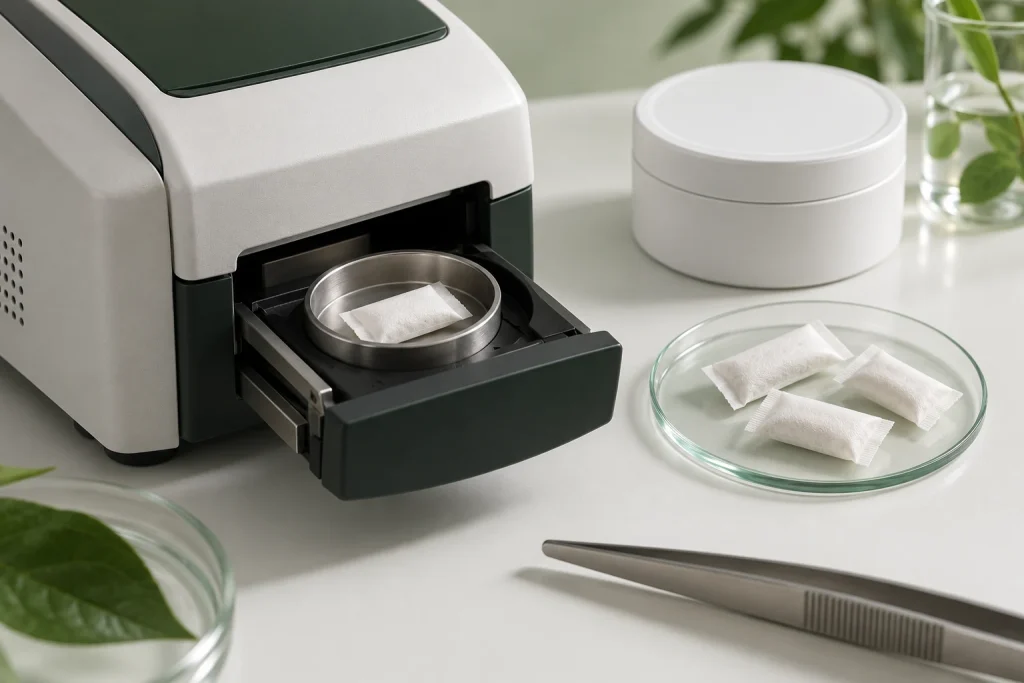
GuaranaPouches.com editorial guide for product development and quality teams. A qualified food-safety team must set product-specific limits.
Why two pouches with the same moisture can behave differently
The water-activity reference hosted by USDA Agricultural Research Service explains that foods with equal moisture content can have different water activities. Ingredients change how water is held within a formulation. For a pouch developer, that makes “same moisture as the approved sample” an incomplete substitution rule when changing a carrier or humectant.
Consider two hypothetical samples that each report 20% moisture. That single number does not tell the buyer whether either sample meets an agreed water-activity specification. The missing measurement should remain blank until tested; it should not be estimated from softness or copied from the other flavor. Pouch feel is useful sensory information, but a soft sample is not a microbial assessment. Keep the sensory description, moisture result and water-activity result as separate fields in the development record.
| Measurement | Typical reporting form | Buyer question |
|---|---|---|
| Moisture content | % by mass, method stated | How was water measured? |
| Water activity | aw, with test temperature | Was the sample equilibrated? |
| Microbiological testing | Organism or count, method and units | What was tested and against which limit? |
Read water-activity numbers without turning them into safety promises
Water activity is dimensionless. An aw of 0.80 corresponds to 80% equilibrium relative humidity under the same conditions, not 80% moisture by mass. The FDA’s technical guide explains this relationship and why temperature control matters during measurement. Its discussion of 0.85 concerns particular food regulations; it is not a universal approval threshold for guarana pouches.
A low result also does not prove that an ingredient or finished pouch is free of pathogens. FDA’s January 2025 draft guidance on low-moisture ready-to-eat foods notes that environmental pathogens can survive in these foods even when growth is restricted. That document is draft guidance, not a pouch-specific rule. Use the result within a hazard assessment that also considers ingredients, handling, packaging and intended storage.
Ask the laboratory to define the sample and the method
A report reading “aw: pass” is difficult to compare with a later complaint sample. Ask for the numeric result, test temperature and method reference. Agree whether the laboratory tests the intact pouch, its contents or another defined preparation. Do not assume that results from those preparations are interchangeable.
The purchasing brief should also state when the sample was taken. A fresh blend, a newly packed can and a can held for several months are different sampling points. For an investigation, retain the original packaging and record when the can was opened. These are practical documentation recommendations, not a universal laboratory protocol. The laboratory should specify its validated preparation, calibration checks and equilibrium criteria. That detail makes a repeat measurement interpretable when the result is close to a contractual limit.
Useful fields in a test request
- SKU, flavor, lot and manufacturing date.
- Sample preparation and unopened or opened-pack status.
- Test temperature, method and equipment identification.
- Individual results and the agreed reporting rule.
- Acceptance limit with its technical justification.
Include the finished can in the stability review
A release measurement describes the sample at that point in time. It does not establish performance throughout the proposed shelf life. Request data from the intended pack and record the formulation and packaging versions used in the study. If the supplier changes a lid, liner or pouch material, ask whether the earlier study still represents the new combination.
A useful review keeps water activity beside the moisture, sensory and microbiological records instead of collapsing them into one “freshness” score. Define separate criteria and an investigation route for an unexpected result. The guarana pouch stability guide covers the wider study; the packaging document checklist addresses material suitability. A supplier’s shelf-life statement should identify the pack and storage conditions to which it applies.
Frequently asked questions
Can moisture percentage predict the water activity of a guarana pouch?
Not by itself. The relationship depends on the formulation and temperature. Request an actual water-activity result rather than a conversion from moisture percentage.
Is a water activity below 0.85 enough to release a batch?
No universal guarana pouch release decision follows from that number. The release decision requires justified product-specific criteria and the other checks in the quality and food-safety plan.
Does a low water-activity result replace microbial testing?
No. Water activity describes a condition affecting growth. Microbiological tests examine specified organisms or counts in the samples tested. Neither should be represented as proof of sterility.
References and scope
- USDA ARS-hosted CSIRO reference: Water Activity in Food.
- FDA technical guide: Water Activity in Foods.
- FDA January 2025 draft sanitation guidance for low-moisture ready-to-eat foods.
- Guarana pouch contaminant and microbiological testing.
References checked 29 October 2026. General food-science principles are applied here to purchasing questions; the sources do not validate a particular guarana pouch.
{“@context”:”https://schema.org”,”@graph”:[{“@type”:”BlogPosting”,”@id”:”https://www.guaranapouches.com/guarana-pouch-water-activity-vs-moisture-content/#article”,”headline”:”Guarana pouch water activity vs moisture: what buyers should test”,”description”:”Why moisture percentage cannot replace water activity in guarana pouch quality checks, and which sampling details buyers should request.”,”mainEntityOfPage”:”https://www.guaranapouches.com/guarana-pouch-water-activity-vs-moisture-content/”,”image”:[“https://www.guaranapouches.com/wp-content/uploads/2026/10/guarana-water-activity.webp”],”datePublished”:”2026-10-28T23:17:29+00:00″,”dateModified”:”2026-10-28T23:17:29+00:00″,”inLanguage”:”en”,”author”:{“@type”:”Organization”,”name”:”GuaranaPouches.com”,”url”:”https://www.guaranapouches.com/”},”publisher”:{“@type”:”Organization”,”name”:”GuaranaPouches.com”,”url”:”https://www.guaranapouches.com/”}},{“@type”:”FAQPage”,”@id”:”https://www.guaranapouches.com/guarana-pouch-water-activity-vs-moisture-content/#faq”,”mainEntity”:[{“@type”:”Question”,”name”:”Can moisture percentage predict the water activity of a guarana pouch?”,”acceptedAnswer”:{“@type”:”Answer”,”text”:”Not by itself. The relationship depends on the formulation and temperature. Request an actual water-activity result rather than a conversion from moisture percentage.”}},{“@type”:”Question”,”name”:”Is a water activity below 0.85 enough to release a batch?”,”acceptedAnswer”:{“@type”:”Answer”,”text”:”No universal guarana pouch release decision follows from that number. The release decision requires justified product-specific criteria and the other checks in the quality and food-safety plan.”}},{“@type”:”Question”,”name”:”Does a low water-activity result replace microbial testing?”,”acceptedAnswer”:{“@type”:”Answer”,”text”:”No. Water activity describes a condition affecting growth. Microbiological tests examine specified organisms or counts in the samples tested. Neither should be represented as proof of sterility.”}}]}]}