
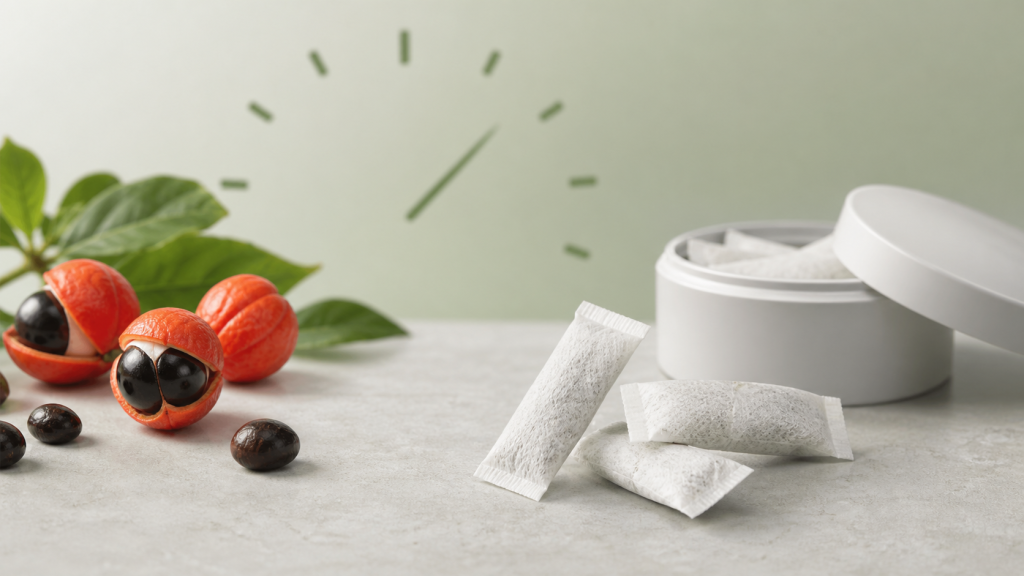
“How long does a guarana pouch last?” can refer to four different clocks: flavor duration, time under the lip, caffeine release from the pouch and caffeine remaining in the body. Treating them as one number creates misleading product claims.
The pouch clock starts with the finished formula
A product made with guarana extract standardized to 20% caffeine has a calculable caffeine input, but the assay does not determine release speed. Moisture, pH, cellulose structure, fill density, pouch-paper permeability and saliva exposure all matter. A 30-minute placement instruction does not prove that all caffeine is released in 30 minutes.
Perceived effect is not a release test
People may notice caffeine differently depending on habitual use, recent food, sleep, body size, medicines and other caffeine consumed that day. A subjective “kick” is therefore not a reliable analytical endpoint. Finished-pouch dissolution or release testing is needed before a manufacturer describes a specific curve.
Caffeine remains after the pouch is removed
EFSA describes caffeine as rapidly and completely absorbed, with an average half-life of about four hours in healthy adults, while individual values vary substantially. Half-life means that the body eliminates roughly half of the circulating amount over that period; it does not mean the effect switches off at four hours. Pregnancy, medicines and other factors can extend clearance.
Why late-day use matters
EFSA notes that 100 mg close to bedtime may affect sleep duration and patterns in some adults. Even a lower-dose pouch can contribute to sleep disruption when combined with coffee, tea, energy drinks or earlier pouches. Removal time cannot be used as a shortcut for total exposure.
What brands should publish
State caffeine per pouch, suggested maximum placement time where appropriate and the basis for any release language. Avoid “lasts all day,” “instant absorption” and “no crash” unless the precise claim is supported by suitable finished-product and human evidence.
References
Content reviewed: . Review dates indicate editorial maintenance, not a new clinical study.