
A guarana pouch lot code is useful only when the manufacturer can connect it to ingredient batches, production records, finished cans and customer shipments. Before approving a private-label order, ask the supplier to demonstrate that connection using one completed batch. A certificate of analysis and a barcode are supporting records; neither, on its own, shows where every affected can went.
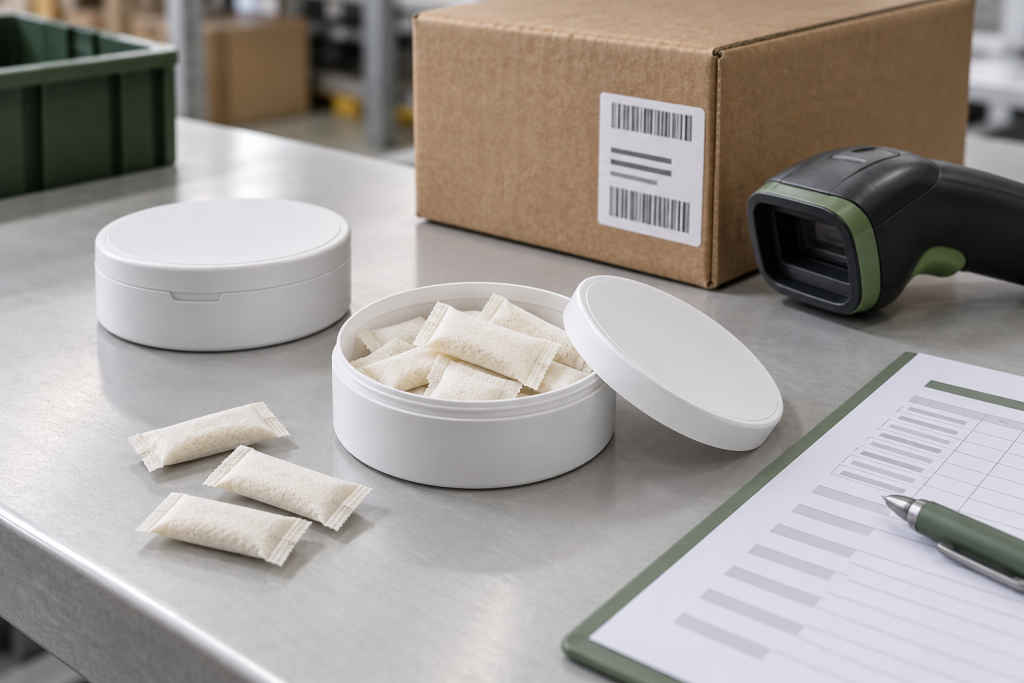
Published by GuaranaPouches.com. This is a supplier-side purchasing guide, not an independent factory audit. The example quantities below are hypothetical.
What should a guarana pouch batch number identify?
The code printed on the can should resolve to a defined production lot. That definition needs to survive a change of shift, a packaging interruption or a split shipment. A buyer should be able to ask for the code on a received can and obtain the corresponding manufacturing record without guessing which invoice applies. SKU and lot are different identifiers: a mint product can keep the same SKU across many production runs.
GS1’s traceability framework describes Critical Tracking Events, such as receiving and shipping, and Key Data Elements recorded for those events. Applied to a pouch purchasing review, this suggests checking both the identity of the material and its movement. The checklist below is an editorial application of that framework, not a claim that this website or a particular supplier holds GS1 certification.
- Finished-product SKU, flavor and declared caffeine content.
- Manufacturing lot and packaging lot, including their relationship if different.
- Ingredient lot references and the version of the approved formula.
- Finished-can quantities and release status.
- Shipment references, destinations and quantities.
Link the guarana extract to the finished can
A supplier may purchase one guarana extract lot and use it in several pouch batches. Conversely, a production campaign may use more than one incoming ingredient lot. Ask how those relationships are recorded, especially when material is transferred between containers or a partially used container returns to storage. An internal material code should still lead back to the original supplier lot and its supporting documents.
For an extract specified at 20% caffeine, retain the actual batch assay, its reporting basis and the approved ingredient specification. The percentage describes that standardized ingredient; it does not establish a universal caffeine content for guarana plants or prove the caffeine content of the finished pouch. Match the incoming documentation to the finished-product caffeine test. Packaging also belongs in the record: can, lid, pouch material and artwork versions can each matter when investigating a complaint.
Questions worth asking during a supplier review
- Can the extract lot be traced forward to every finished batch that used it?
- Can a finished can be traced backward to its ingredient and packaging lots?
- How are relabeling, repacking and rework recorded, when permitted?
- Who can change a record, and is the earlier version retained?
Use a quantity reconciliation to test the records
A practical mock exercise starts with a finished lot and asks where its cans are now. Consider an illustrative lot containing 9,000 cans: 5,400 dispatched, 3,300 still held in stock, 180 retained for sampling and 120 documented as damaged. Those figures reconcile to 9,000. If the records account for only 8,700, the missing 300 require investigation. This arithmetic is a training example, not an account of our production or a regulatory acceptance limit.
The exercise should preserve the distinction between manufactured, released, shipped and recovered quantities. A delivery confirmation proves dispatch or receipt at a destination; it does not prove that every can was subsequently recovered. Request a written explanation for discrepancies and record when the exercise started and finished. The appropriate performance target should be agreed through the supplier’s risk assessment and applicable requirements, rather than copied from an unsupported industry benchmark.
Agree ownership before the first shipment
Private-label arrangements can divide information across the brand owner, contract manufacturer and fulfillment partner. Ask who maintains the customer distribution list and who can place stock on hold outside normal office hours. The quality agreement should specify access to batch records, complaint escalation, investigation responsibilities and approval of external communications. Avoid leaving those decisions until a real complaint arrives.
Keep consumer-facing contact details consistent with the responsible business. A QR code can offer a convenient route to product information, but the system also needs a readable lot code and a durable record behind it. For this site’s oral pouch orders, the commercial minimum is 3,000 cans per SKU and 9,000 cans per order. That ordering threshold does not define a manufacturing lot. Specify the proposed SKU quantities and request the traceability documentation in the RFQ.
Frequently asked questions
Is an expiry date enough to trace a guarana pouch?
An expiry date alone may be shared by multiple production lots. Ask for a lot identifier that resolves to production and distribution records.
Does a certificate of analysis prove recall readiness?
No. It reports specified test information for an identified sample or batch. Recall readiness also requires records showing which finished products and destinations are affected.
Does a 9,000-can order have to be one production lot?
No such assumption should be made. Order quantity and manufacturing lot definition are separate. Confirm the lot structure with the manufacturer before production.
References and scope
Source checked on 22 October 2026: GS1 traceability framework. Further supplier-review reference: GS1 Global Trace Check List. The purchasing examples and questions here are our editorial analysis. They do not certify a supplier, establish a legally sufficient recall plan or replace requirements for the destination market.