
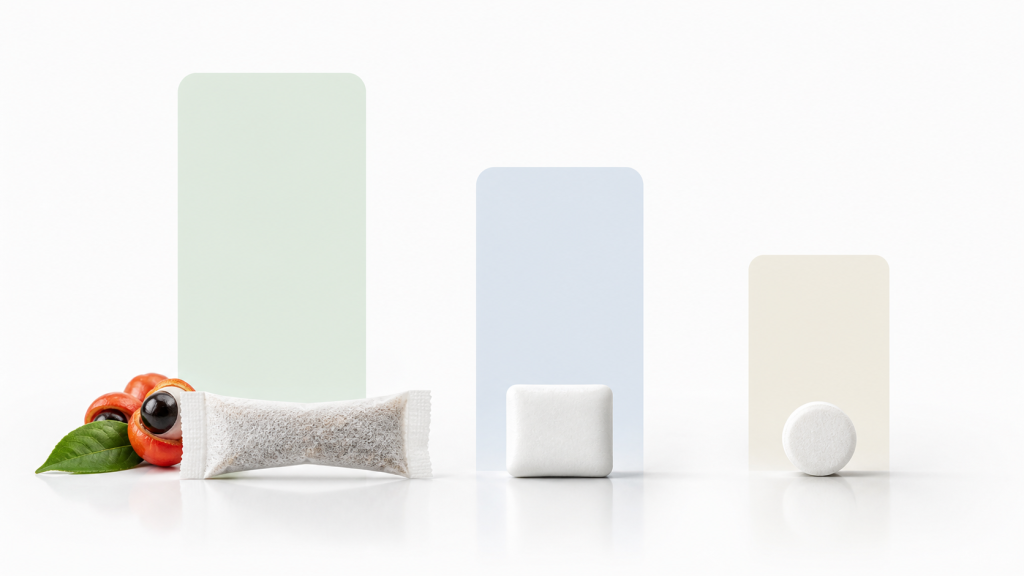
Pouches, gum and tablets are delivery formats—not three different caffeine molecules. The useful comparison begins with measured caffeine per unit and continues with how the complete product is used.
Guarana pouch
A pouch can use standardized guarana extract, purified caffeine or both. With a 20% extract, 250 mg theoretically supplies 50 mg caffeine. Moisture, paper and formula influence release, so an exact onset or duration should not be assumed from the botanical source. The pouch offers a discreet, beverage-free format but also creates oral-contact and flavor-design considerations.
Caffeine gum
Chewing disperses ingredients through saliva and changes the physical matrix continuously. Published pharmacokinetic work on specific caffeinated gums cannot automatically be transferred to every gum—or to a pouch. Dose per piece, chewing protocol and swallowed fraction matter.
Caffeine pills
Tablets and capsules are swallowed and commonly provide a fixed labeled dose. They avoid prolonged gum contact but may carry a higher unit dose than a pouch or gum. “One pill” is not a comparison unit unless its caffeine milligrams are known.
| Decision point | Pouch | Gum | Pill |
|---|---|---|---|
| Dose check | mg per pouch | mg per piece | mg per tablet/capsule |
| Use behavior | Placed under lip | Chewed | Swallowed |
| Sensory load | Flavor over placement | Flavor while chewing | Usually minimal |
| Evidence needed | Finished-pouch release data | Product-specific gum data | Product-specific dissolution data |
Avoid the “faster is better” trap
A faster rise is not automatically safer or more useful. Compare total daily caffeine, individual sensitivity and timing. FDA emphasizes counting caffeine from all sources regardless of whether it occurs naturally or is added.
Reference
Content reviewed: . Review dates indicate editorial maintenance, not a new clinical study.