
Minimum Order Quantity (MOQ)
For our oral pouch products, the minimum order is 3,000 cans per SKU, with a minimum total of 9,000 cans per order. Both requirements apply.
- Per SKU: at least 3,000 cans.
- Total order: at least 9,000 cans.
- Quantities refer to cans, not individual pouches.
Please include the required quantity for each SKU when requesting a quotation.
Direct answer: a useful guarana pouch RFQ must define the target market, verified caffeine per pouch, guarana extract specification, physical pouch parameters, test package, packaging configuration and commercial assumptions. “Please quote a natural energy pouch” is not a production brief.
Start with market, product classification and intended user
State the countries where the product will be sold, the proposed product category and the intended adult consumer. These choices affect ingredient review, warnings, permitted claims, label format and required documentation. Do not ask a manufacturer to “make it compliant worldwide”; one global formula and label may not fit every destination. Identify whether the quotation should cover formula development, manufacture only, packaging, regulatory review, freight or a complete turnkey program. Name the party responsible for final label approval. If the United States dietary-supplement route is contemplated, ask qualified counsel to confirm applicability rather than assuming that an oral pouch automatically belongs in one category.
- Target countries and sales channels
- Proposed classification and adult positioning
- Required services and regulatory responsibility
- Launch date and forecast assumptions
Define caffeine and guarana with numbers
Specify total caffeine per finished pouch and the acceptable assay range. If using guarana extract standardized to 20% caffeine, name the botanical species, plant part, extraction details where relevant, carrier, caffeine specification and test method. At exactly 20%, 250 mg extract theoretically contributes 50 mg caffeine, but the RFQ must also say whether any purified caffeine or other caffeine-bearing ingredient is permitted. Request a lot-specific raw-material COA and finished-product verification. Avoid ambiguous phrases such as “50 mg guarana caffeine” unless the document clearly distinguishes extract weight from caffeine weight. Define whether overage is allowed and who approves it.
- Target caffeine in mg per pouch
- Guarana extract weight and caffeine assay range
- Permitted additional caffeine sources
- Finished-product assay and uniformity criteria
Specify the physical pouch instead of writing “slim”
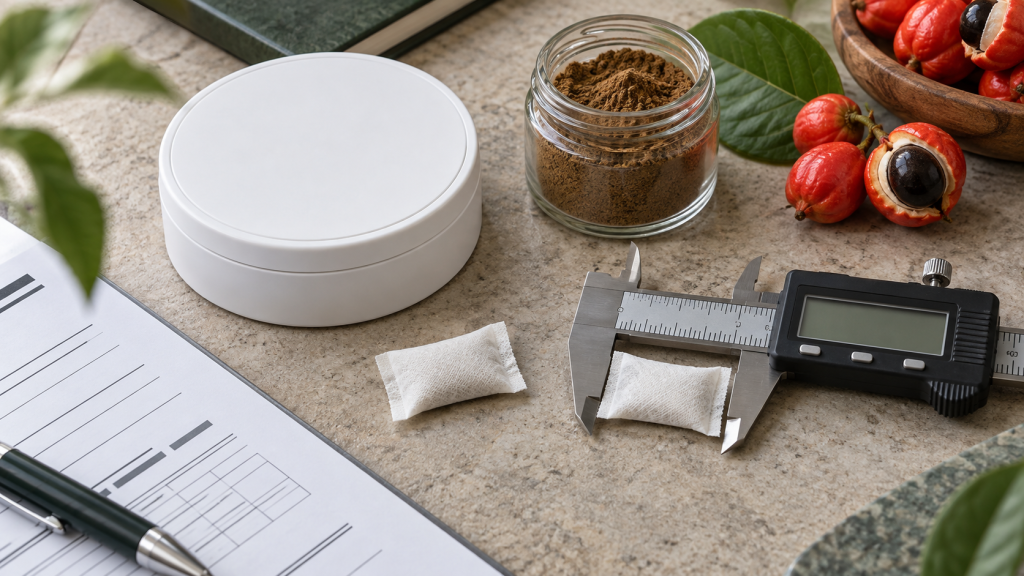
Words such as mini, slim and regular are supplier-relative. Put length, width, target fill weight, weight tolerance, thickness envelope and seal-width requirement in the RFQ. Describe the desired short, flat, softly filled profile and provide a physical reference solely for proportions where appropriate. Define nonwoven grade, food-contact documentation, permeability expectations, seam type and seal-strength test. Add target moisture and pH with the measurement method, because the number is meaningless without sample preparation and test conditions. State whether the pouch must survive shipping vibration, hot storage or repeated can opening without leaking powder or losing its intended texture.
- Length × width × thickness envelope
- Fill weight and unit-weight tolerance
- Nonwoven material and seal specification
- Moisture, pH and integrity methods
Build the testing package before asking for price
Define identity, caffeine assay, unit uniformity, microbiological limits, heavy metals, pesticides where relevant, moisture, pH and sensory release acceptance. Shelf life should be supported by a written stability protocol covering the finished formula in its final container, not borrowed from a raw ingredient. Ask which tests are performed per lot, which are periodic and which laboratory conducts them. FDA’s dietary-supplement CGMP guidance, when applicable to a U.S. project, describes written specifications, master manufacturing records and batch production records; it does not make a generic facility certificate a substitute for product-specific controls. The RFQ should request actual document names rather than a vague “full certification” promise.
Lock packaging, MOQ and ownership assumptions
State pouches per can, can material, closure, tamper evidence, desiccant or compartment requirements, label construction, carton count and shipper configuration. Ask for MOQ by flavor and SKU—not only total order quantity—and separate tooling, artwork, sampling, testing and freight costs. Define the number of sample rounds, what counts as a revision and the conditions that restart the timeline. Clarify ownership of formula, flavor work, artwork, tooling and test data, plus any exclusivity or confidentiality terms. Forecast information should distinguish a launch order from expected repeat volume. A realistic quotation cannot be compared until suppliers are pricing the same deliverables, acceptance criteria and Incoterm.
Twenty-five-line RFQ checklist
- Target market
- Product classification
- Intended adult user
- Total caffeine per pouch
- Guarana extract specification
- Additional caffeine sources
- Formula exclusions
- Flavor direction
- Sweetener system
- Pouch length
- Pouch width
- Fill weight
- Nonwoven grade
- Seal requirement
- Moisture range
- pH range and method
- Finished-product assay
- Uniformity criterion
- Contaminant testing
- Stability protocol
- Pouches per can
- Packaging configuration
- MOQ by SKU
- Sample and production timeline
- Ownership, Incoterm and payment assumptions
Source
Frequently asked questions
What should a guarana pouch RFQ include?
It should define market, caffeine per pouch, extract specification, physical pouch dimensions, test methods, packaging, MOQ by SKU, timing, ownership and commercial terms.
How should 20% guarana extract be written in an RFQ?
State extract weight, caffeine assay range, botanical identity, test method and the target total caffeine per finished pouch.
Should an RFQ specify pouch dimensions?
Yes. Mini, slim and regular are not universal dimensions; specify length, width, fill weight, thickness envelope and seal requirements.
Is a manufacturer certificate enough for product approval?
No. Facility documents do not replace raw-material specifications, finished-product tests, stability evidence or market-specific regulatory review.
Content reviewed: September 29, 2026. Review dates indicate editorial maintenance, not a new clinical study.