
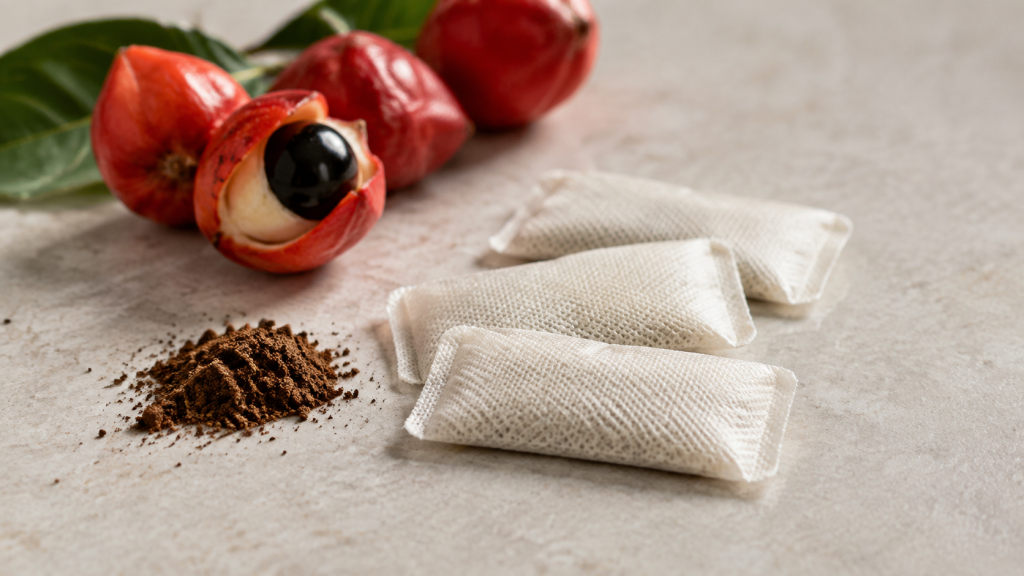
Short answer: a guarana caffeine pouch releases caffeine into saliva, but it is too simple to say that the entire dose goes “straight through the gums.” Some caffeine may cross the oral mucosa, while some caffeine-containing saliva is swallowed and absorbed through the gastrointestinal tract. The proportion depends on the finished pouch and has not been established for guarana pouches as a category.
Release, absorption and effect are three different steps
First, moisture enters the pouch and dissolves caffeine from the formulation. Second, dissolved caffeine leaves the nonwoven material and mixes with saliva. Third, caffeine can potentially cross oral tissue or be swallowed. A user feeling an effect does not reveal which route supplied most of the dose, and a fast flavor release does not prove equally fast caffeine absorption.
What guarana research can—and cannot—tell us
A laboratory study comparing guarana with an equivalent amount of free caffeine found no significant difference in caffeine dissolution at pH 2 or 6.8. Its intestinal model likewise found no significant difference in uptake. This supports a practical formulation point: once the caffeine dose is matched, guarana should not automatically be marketed as a uniquely slow-release caffeine source.
That study used capsules and an experimental intestinal model, not modern oral pouches or human buccal tissue. It cannot establish the onset time, mucosal absorption fraction or user experience of a particular pouch.
What research on caffeinated gum suggests
Human pharmacokinetic work with caffeinated chewing gum reported faster absorption than capsules and suggested that buccal absorption may contribute. Gum, however, is chewed and distributes dissolved caffeine throughout the mouth; a pouch normally remains in one location. The formats are useful comparators, not interchangeable products.
Why pouch design changes the release curve
- Moisture: a wetter pouch may begin dissolving soluble ingredients sooner.
- pH: pH influences the chemical environment, oral comfort and ingredient behavior.
- Particle size and blending: these affect contact with saliva and unit uniformity.
- Nonwoven permeability: pore structure and seal quality influence liquid movement.
- Placement and contact time: saliva flow and the way a person uses the pouch vary.
These variables are why a supplier cannot infer a finished-product release profile from the raw-material specification alone.
How the 20% guarana calculation fits in
“20% caffeine” is a standardized extract specification, not a fixed value for every guarana seed or powder. If a production lot assays at exactly 20%, 250 mg of that extract theoretically contributes 50 mg caffeine. That arithmetic describes the formulated input. It does not show how quickly 50 mg leaves the pouch or how much reaches circulation.
| Question | Required evidence |
|---|---|
| How much caffeine is formulated? | Lot assay, batch record and blend calculation |
| How much is in each finished pouch? | Validated finished-product assay and uniformity testing |
| How quickly does caffeine leave the pouch? | Time-point release or extraction testing |
| How quickly does it reach the blood? | Human pharmacokinetic study on the finished product |
A better way to read product claims
Look for caffeine per pouch, not just milligrams of guarana extract. Treat “fast acting,” “buccal delivery” and minute-by-minute onset claims as product-specific claims that require matching data. People who are caffeine-sensitive should also count coffee, tea, energy drinks, supplements and medicines when assessing total intake.
Sources
- Dissolution and absorption of caffeine from guarana
- Caffeine absorption from chewing gum versus capsules
Frequently asked questions
Do guarana pouches absorb through your gums?
Some dissolved caffeine may cross the oral mucosa, while some is swallowed in saliva and absorbed through the gastrointestinal tract. The split has not been established for all guarana pouches.
Do caffeine pouches work faster than coffee?
That cannot be assumed from the format alone. Dose, solubility, pouch release, use conditions and the comparator all affect onset; a finished-product study is needed for a precise claim.
Does 20% guarana mean 20% of the pouch is caffeine?
No. It usually means the specified guarana extract contains 20% caffeine. At that exact assay, 250 mg extract theoretically contributes 50 mg caffeine before finished-product verification.
Content reviewed: . Review dates indicate editorial maintenance, not a new clinical study.