
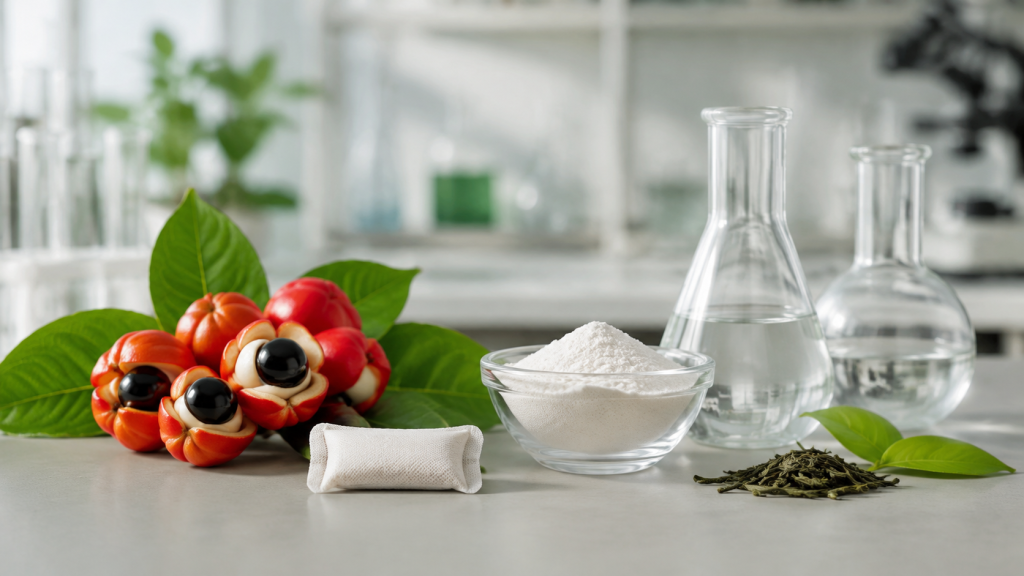
Short answer: caffeine and L-theanine have been studied together in small human trials, with some evidence of short-term attention benefits. That does not prove that every guarana-and-theanine pouch provides “calm energy,” prevents jitters or works at any chosen ratio.
Start with the actual caffeine dose
Guarana is not a separate stimulant category; its most relevant active for this discussion is caffeine. If an extract is standardized to exactly 20% caffeine, 250 mg theoretically contributes 50 mg caffeine. Production calculations should use the lot-specific assay, and the finished pouch should be tested.
What direct research has examined
In a randomized crossover study of 27 healthy volunteers, researchers compared placebo, 50 mg caffeine and 50 mg caffeine combined with 100 mg L-theanine. The combination improved certain attention-switching and distraction measures at specific time points. It was an acute study using swallowed ingredients—not a guarana pouch trial.
A more recent systematic review and meta-analysis found that results across tea, L-theanine and caffeine-plus-theanine studies were inconsistent, with much of the observed effect apparently driven by caffeine. Different doses, tests and populations make a universal “best ratio” difficult to defend.
Why the popular 2:1 ratio is not a law
The 100 mg L-theanine plus 50 mg caffeine study is often converted into a simple 2:1 rule. That ratio describes one tested condition, not a validated requirement for every user or delivery format. Other studies have used materially different quantities. Formulators should choose a target from evidence, product positioning, safety review and sensory feasibility rather than copying a number from a blog.
Pouch formulation adds new variables
A pouch must control more than the ingredient list. Moisture, pH, nonwoven permeability, particle size and contact time can change release. L-theanine also adds mass and can affect taste and blend uniformity. Evidence from capsules or drinks cannot establish buccal release, onset or finished-product efficacy.
Claims that need particular care
- “Eliminates caffeine jitters”
- “No crash” or “anxiety-free energy”
- “Clinically proven ratio” without matching the tested product
- Guaranteed focus, productivity or ADHD-related claims
A defensible product page states caffeine and L-theanine per pouch, identifies the caffeine source, avoids disease language and distinguishes ingredient research from finished-product evidence.
Development checklist
- Define caffeine per pouch from the 20% extract assay.
- Set L-theanine specification, purity and acceptance range.
- Validate mixing and unit-to-unit uniformity.
- Measure release of both actives where the claim depends on timing.
- Run sensory and oral-tolerance work on the final formula.
Sources
- Randomized trial: combined L-theanine and caffeine
- Systematic review and meta-analysis: tea, L-theanine and caffeine
Frequently asked questions
What is the best L-theanine-to-caffeine ratio in a pouch?
No universal best ratio has been established. A frequently cited trial used 100 mg L-theanine with 50 mg caffeine, but that does not validate every product or user.
Does L-theanine remove caffeine jitters?
Evidence does not support a guarantee. Individual response, caffeine dose and the finished formulation still matter.
How much caffeine comes from 20% guarana extract?
At an exact 20% assay, 250 mg extract theoretically provides 50 mg caffeine; manufacturers should calculate from the actual lot result and verify the finished pouch.
Content reviewed: . Review dates indicate editorial maintenance, not a new clinical study.