
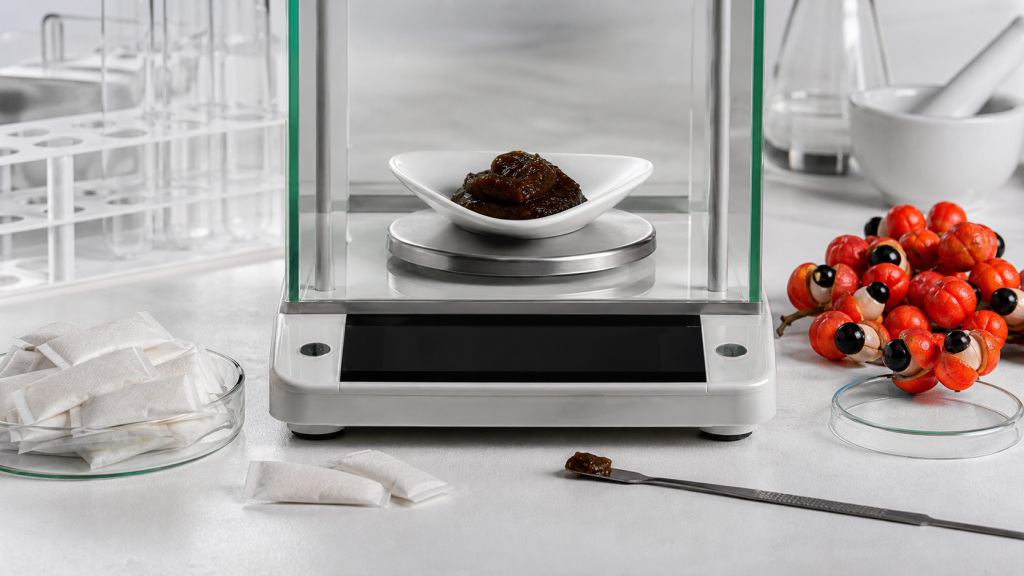
The nominal calculation is simple: a 50 mg caffeine target divided by 20% equals 250 mg of extract. A production formula, however, must use the actual lot assay and control every step between weighing and the finished pouch.
Begin with the certificate result
If the incoming lot assays at 20.8% caffeine, the theoretical extract requirement is 50 ÷ 0.208 = 240.4 mg per pouch. If it assays at 19.8% and still meets an approved specification, the calculation becomes 252.5 mg. Using “250 mg” without reviewing the COA silently changes the dose.
Scale the calculation to the batch
For 100,000 pouches at 240.4 mg extract each, the theoretical input is 24.04 kg before justified process adjustments. Include every other caffeine-bearing ingredient in the total. Overages should never be arbitrary; they require stability and process data plus a defined upper specification.
Uniformity is the real manufacturing challenge
Standardized extract may differ from cellulose carrier and flavor powders in density, particle size or electrostatic behavior. A validated pre-blend can reduce segregation. Addition order, screen size, mixer fill, time and transfer route should be fixed before scale-up. Sample early, middle and late production rather than relying on one composite.
Build a meaningful finished specification
- Caffeine per pouch with justified acceptance limits
- Individual and average fill weight
- Blend or dosage-unit uniformity
- Moisture or water activity
- Seam integrity, microbiology and sensory profile
Finished-pouch assay is the release decision. The raw-material COA confirms the ingredient; it cannot detect filling drift or segregation during manufacture.
Label the dose plainly
Consumers should be able to find total caffeine per pouch without performing an extract calculation. “250 mg guarana extract” and “50 mg caffeine” communicate different facts and should not be treated as substitutes.
References
Content reviewed: . Review dates indicate editorial maintenance, not a new clinical study.