
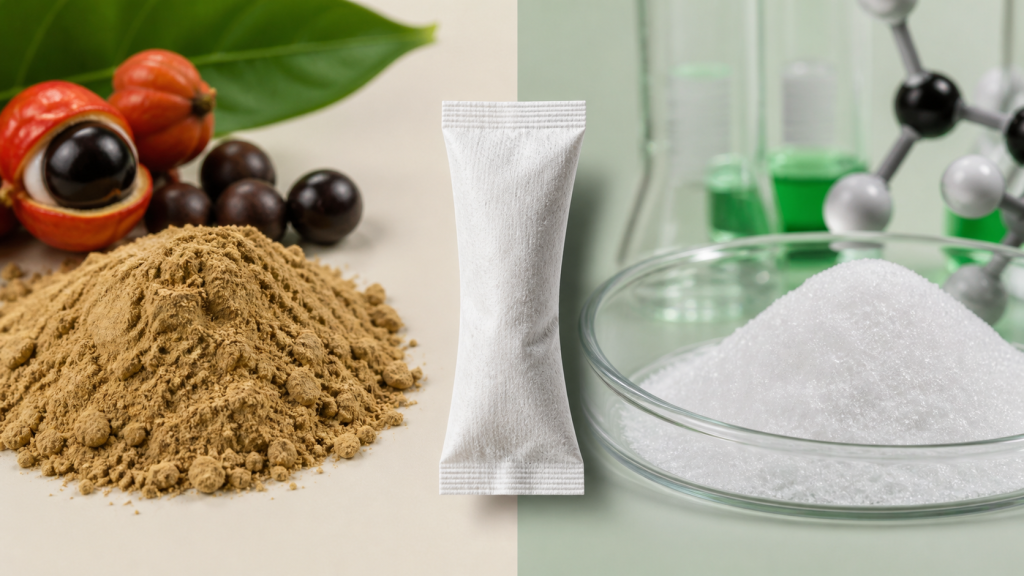
A standardized guarana extract and caffeine anhydrous can both supply caffeine, but they are not interchangeable raw materials. The choice affects inclusion weight, flavor, botanical substantiation and process control.
The concentration difference is substantial
At a 50 mg caffeine target, an extract assaying exactly 20% requires a theoretical 250 mg per pouch. Caffeine anhydrous, depending on its approved assay, requires roughly one-fifth that mass. The additional guarana-extract solids may include native plant constituents and a declared drying carrier.
Botanical identity requires more than a caffeine peak
USP’s work on guarana standards uses chromatographic profiles containing caffeine and flavonoid markers such as catechin and epicatechin. A caffeine result alone cannot demonstrate that a material is authentic Paullinia cupana. Procurement should review identity, plant part, extraction system and carrier alongside the assay.
Formulation behavior differs
Guarana extract typically contributes more color, bitterness, astringency and hygroscopic load than purified caffeine at the same caffeine dose. Caffeine anhydrous is also bitter and requires careful dispersion. Particle size and bulk density determine segregation risk; the word “natural” does not solve a mixing problem.
Do not assume a different physiological effect
FDA notes that the body does not handle naturally occurring caffeine differently from caffeine added to a product. Guarana contains other constituents, but that does not justify automatic promises of slow release, no jitters or no crash. Those claims need finished-product and, where relevant, human evidence.
When a brand may choose each option
A traceable guarana extract supports a botanical-source proposition and can contribute a broader sensory profile. Caffeine anhydrous supports lower inclusion weight and a simpler caffeine calculation. Some formulas use both, but the label and specifications must disclose and count total caffeine from every source.
References
Content reviewed: . Review dates indicate editorial maintenance, not a new clinical study.