
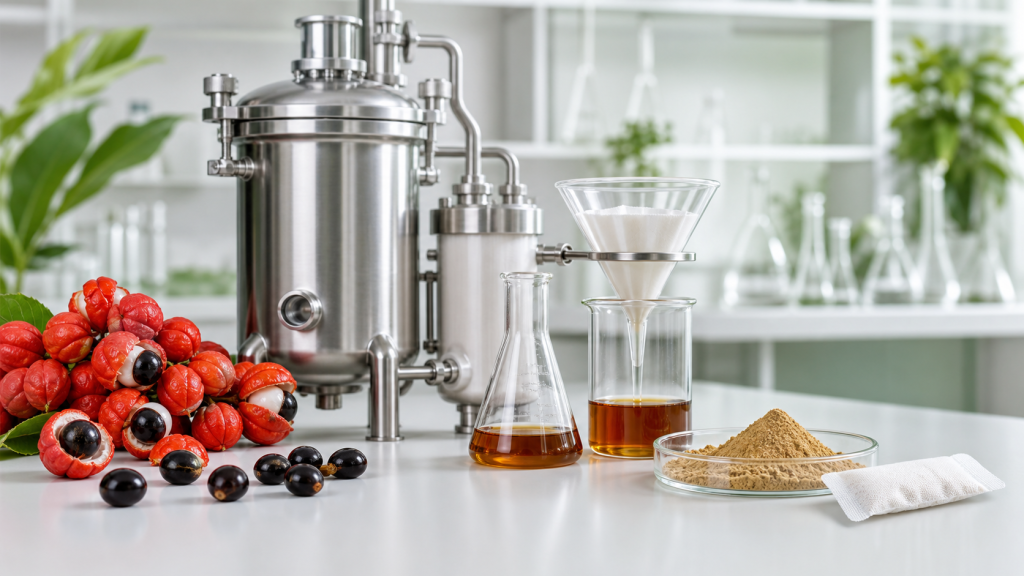
A pouch ingredient labeled “guarana extract standardized to 20% caffeine” has traveled well beyond simple seed grinding. The percentage is a controlled ingredient specification created and verified through processing and analysis.
1. Seed identity comes first
The botanical should be identified as Paullinia cupana, with the seed named as the plant part. USP’s guarana standards use chromatographic markers that include caffeine and characteristic flavonoids. Caffeine alone cannot prove botanical identity.
2. The seed is prepared for extraction
Cleaning, drying and milling increase consistency and surface area. Agricultural origin, maturity and storage affect the starting composition, so processors cannot assume every incoming lot contains the same caffeine level.
3. Soluble constituents are extracted
Water, water–ethanol mixtures or another permitted solvent system may be used according to the intended specification. Time, temperature, solvent ratio and solid-to-liquid ratio determine which compounds move into solution. The extract is then separated from insoluble seed material.
4. Concentration and drying create a powder
Filtered liquid is concentrated and commonly spray-dried or otherwise converted to dry extract. A suitable carrier may be added to improve drying, flow or stability. The carrier must be disclosed because it affects inclusion weight, labeling and sensory behavior.
5. Standardization targets the caffeine range
Processors may blend qualified extract lots or adjust with permitted components to reach a defined range. “20%” should state whether it is a minimum, nominal value or acceptance interval. It must not be interpreted as the natural caffeine content of all guarana seed.
6. The released lot is tested
HPLC assay confirms caffeine concentration, while identity, moisture, residual solvents, contaminants and microbiology answer separate questions. The pouch manufacturer then uses the actual lot result to calculate input and verifies caffeine in the finished product.
References
Content reviewed: . Review dates indicate editorial maintenance, not a new clinical study.