
A pouch called “Focus” or “Nootropic” can contain caffeine. A nicotine-free statement does not resolve that question. For a guarana formula, check the exact product variant, the complete ingredient panel and a finished-product caffeine result before treating it as caffeine-free.
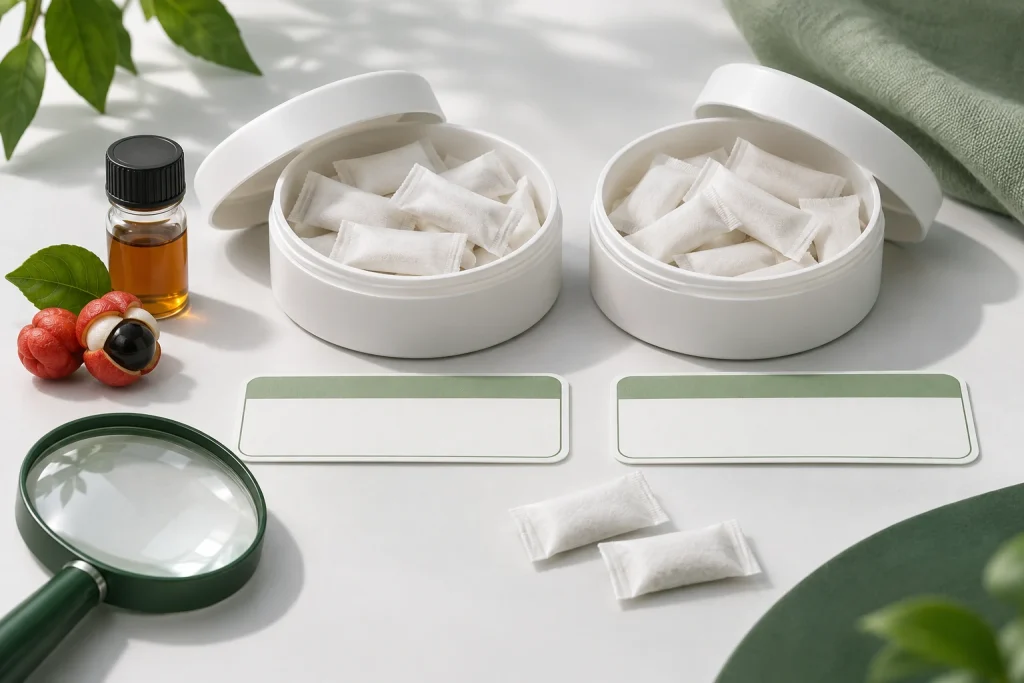
GuaranaPouches.com editorial guidance for adult readers and private-label buyers. This is a label and evidence review, not a recommendation to use nootropics or a treatment for nicotine dependence.
Separate the product name from the formulation
Reddit discussions about nicotine-free alternatives often mix caffeinated energy products with caffeine-free products sold under similar names. In a discussion about nootropic pouches, the original question specifically concerned caffeine-free products, while a later brand-affiliated reply described a caffeinated formula. That exchange illustrates a classification problem; it does not establish whether either product works.
Ask for the variant identifier, not just the brand name. A manufacturer may offer several formulas under one family of packaging. Keep photographs of the front panel, ingredient list and serving instructions together. If an online listing and the delivered can disagree, request clarification before use. A “zero” printed prominently on a package needs a defined object: zero nicotine, zero sugar and zero caffeine are different claims.
Read blends without inventing missing quantities
Operation Supplement Safety explains that a proprietary blend on a US dietary-supplement label may disclose a combined weight without the amount of every component. A 300 mg blend containing several botanicals cannot be treated as 300 mg of guarana, or as 300 mg of caffeine. Its total weight is insufficient to calculate either figure.
A useful supplier response distinguishes the input specification from the finished formula. It identifies all caffeine-bearing ingredients and provides total caffeine per pouch. If a brand claims caffeine-free, ask how that claim was verified, including the analytical method and reporting limit. A result reported as “not detected” is bounded by the method’s detection capability. It is not an unlimited statement that no molecule is present. Market-specific labeling review still applies.
Do not borrow evidence from a different finished product
A paper about an ingredient does not establish the performance of every pouch containing its name. Match the studied material, amount, administration route and outcome before using research in a product brief. A capsule study and an oral pouch may differ on all four. A formula containing several mushrooms or amino acids also needs more explanation than a list of ingredients that sound familiar.
- Record the exact ingredient identity and amount per pouch.
- Ask whether the study tested that material or a different extract.
- Separate ingredient research from tests on the finished pouch.
- Keep caffeine assay reports separate from cognitive-performance claims.
For the site’s existing caffeine calculations, see the dry-basis COA guide. A 20% standardized extract is a particular ingredient specification, not the natural caffeine concentration of every guarana seed.
Write separate briefs for energy and caffeine-free projects
Our services and private-label pages describe formulation and packaging work. An energy-pouch brief and a caffeine-free oral-format brief should have separate product codes, ingredient approvals and label checks. Removing a caffeine source changes the formula; it does not automatically validate replacement ingredients or their proposed claims.
A buyer can request a caffeine-free concept for feasibility assessment without assuming that any advertised “focus” effect is established. Specify the target market and the intended statement on the label first. Obtain a written response on ingredient suitability, testing and claim support before approving artwork. This editorial distinction does not announce a new stock product or promise that a particular formula is available.
Frequently asked questions
Can two pouches with the same brand name have different caffeine status?
Yes. Compare the exact variant, ingredient panel and caffeine declaration. Do not carry a caffeine-free statement from one flavor or product line onto another without documentation for that SKU.
Does a “Focus” pouch mean caffeine-free?
No. Focus is a product name or positioning term. It does not identify the stimulant content. Request the formula’s total caffeine per pouch and the ingredients responsible for it.
Can a guarana-containing blend be assumed to contain no caffeine because none is listed separately?
No. Guarana may contribute caffeine even when caffeine is not listed as a separate added ingredient. The ingredient panel alone may not quantify that contribution; ask for a finished-product result.
Does “not detected” prove a caffeine-free claim without further information?
No. Request the test method, reporting limit, sample identity and lot. The laboratory result must be interpreted against the intended claim and the rules of the destination market.
Can a mushroom or amino-acid study substantiate a complete pouch formula?
Only if the evidence is relevant to the actual material, amount, route and claimed outcome. An ingredient name shared with a study is not enough to establish the finished pouch’s effect.
Can a brand reuse its energy-pouch artwork for a caffeine-free variant?
It needs a fresh review. Ingredient information, warnings, claims and variant identification must match the new formula. Distinct product codes also help prevent customers from ordering the wrong version.
References and discussion context
Reviewed 16 November 2026. The Reddit thread linked above supplies question context only. The answers and procurement extensions are original editorial analysis. OPSS supplies the proprietary-blend explanation; it does not endorse this website or any pouch. Also read FDA’s dietary-supplement questions and answers for the distinction between marketing and premarket approval. Product classification must be assessed for each market.