
A guarana extract brings more to an assay vial than caffeine. Co-extracted compounds and the finished pouch's flavors can interfere with detection or extraction. A caffeine method should be assessed in the actual matrix before its percentage is used for formulation or release.
Editorial scope: technical development and supplier review. Published 16 November 2026. The study and control suggestions below are not reported results from this supplier.
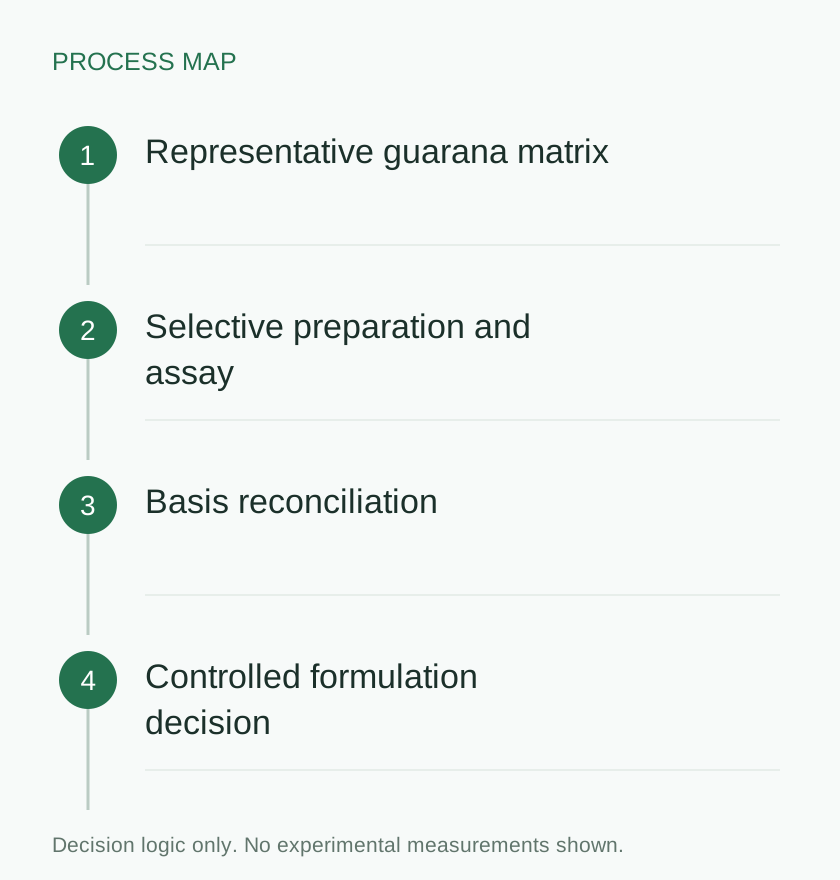
Check the complete analytical path
Review extraction, dilution, filtration and chromatographic separation. A clear solution is not necessarily free from interference. Include representative guarana lots and the intended pouch excipients in the evaluation. If the raw material and finished pouch use different methods, document how results are linked rather than treating them as automatically interchangeable.
Challenge specificity instead of trusting one peak
Use appropriate blanks, standards and spiked preparations. Evaluate whether nearby compounds or degradation products affect the caffeine result. A retention-time match by itself may not resolve co-elution. The required evidence depends on the detector and method; an orthogonal check may be appropriate when a selectivity concern remains.
Keep basis changes visible
An extract assay reported on a dry basis needs a justified conversion before use with an as-received weighed ingredient. Preserve moisture results and the calculation version. If a new lot gives an unexpected result, investigate both matrix behavior and genuine composition change. Do not increase the raw extract addition before understanding the discrepancy and reviewing total caffeine exposure.
Development review checklist
- Evaluate representative extract and flavor matrices.
- Report sample preparation and detector conditions.
- Check spike recovery and potential co-elution.
- State dry-basis or as-received reporting explicitly.
- Investigate unexpected results before adjusting the recipe.
Buyer questions
Does a single caffeine peak prove there is no interference?
No. Selectivity needs appropriate evidence for the matrix and method.
Can a raw-extract method be used unchanged for a finished pouch?
Only after its suitability for the finished matrix is established.
Why do polyphenol-rich extracts complicate a simple UV reading?
Other absorbing compounds can contribute to the signal. A selective validated method is needed.
Should a dry-basis assay be entered directly into a batch sheet?
Confirm the conversion to the material actually weighed and document the moisture basis.
Does a higher measured caffeine result prove adulteration?
No. Investigate basis, sampling, method behavior and traceability before drawing that conclusion.
References and scope
- FDA: ICH Q2(R2), Validation of Analytical Procedures
Fit-for-purpose analytical validation framework; pharmaceutical guidance used as technical background, not a certification for these products.
- ICH Q2(R2), final guideline (2023)
Specificity, recovery, precision and reportable range; product-specific methods require their own validation.
- FDA: Spilling the Beans, How Much Caffeine Is Too Much?
Total caffeine from all sources; 400 mg/day statement limited to most adults, not a target or universal safe limit.
Discuss the specification and evidence needed for your project. Send the intended use, destination market and the attribute you need to verify. Commercial capability and acceptance criteria require a project-specific agreement.