
Grittiness in a guarana pouch deserves a physical investigation. Botanical insoluble matter, agglomerated carrier, nonwoven damage and foreign material are different possibilities. Photographs and a retained sample help the team investigate without deciding the cause from a description alone.
Editorial scope: technical development and supplier review. Published 16 November 2026. The study and control suggestions below are not reported results from this supplier.
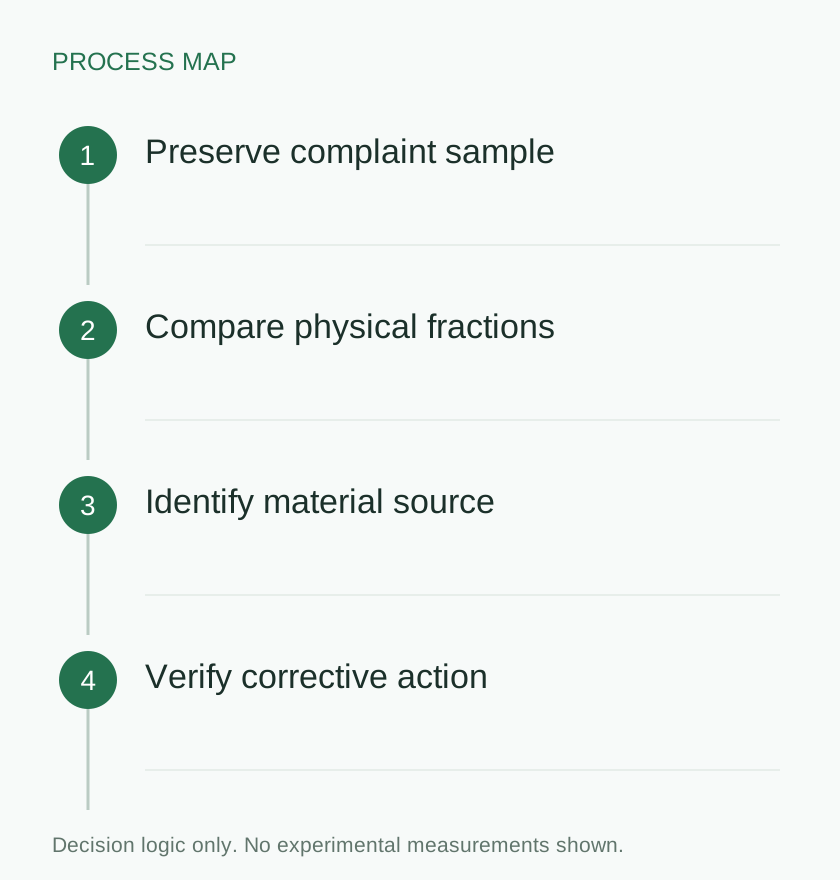
Preserve the sample and separate the observations
Record pouch and can codes, location of the texture, when it was noticed and whether the seam or wrapper appears damaged. Preserve an unopened comparison unit if available. Do not ask a person to keep using an uncomfortable product to gather more data. A consumer report is a starting point, not proof of either contamination or harmless botanical residue.
Compare fractions with suitable methods
An investigation may use visual microscopy, a justified particle-size method and a controlled dispersion or extraction to compare raw material and finished fill. Test blanks and avoid introducing particles from tools. Keep retained solids for identification where needed. Insoluble does not mean inert, and a visible speck cannot be classified by color alone.
Connect the finding to a controlled action
Compare incoming guarana lots, carrier specifications, sieving and mixing records. Determine whether the defect affects the fill, nonwoven or packaging. If a raw-material or process change is proposed, verify active content and other affected attributes after the change. Establish a documented disposition decision for the potentially affected lot and follow the product's complaint procedure.
Development review checklist
- Preserve lot codes and original samples.
- Compare unopened retain units.
- Record pouch integrity before opening.
- Identify particles with a suitable method.
- Assess the affected lot before implementing a correction.
Buyer questions
Does guarana naturally contain insoluble material?
The supplied form can contain insoluble fractions, but that does not explain every gritty complaint or remove the need for a specification.
Can a photograph identify a contaminant?
Usually it can document appearance, not establish composition or safety.
Should the consumer open every remaining pouch?
No. Preserve representative unopened units and follow the complaint instructions.
Can sieving solve an unexplained defect?
It may change a particle distribution, but the source and effect on content and uniformity still need investigation.
Does fine powder guarantee a comfortable pouch?
No. Nonwoven, seams, formulation and use conditions also matter.
What is a useful supplier response?
A traceable investigation, stated findings and limits, lot disposition and verified corrective action, rather than an unsupported reassurance.
References and scope
- FDA: Small Entity Compliance Guide, Dietary Supplement CGMP
Specifications and production records where dietary-supplement classification applies; not automatic classification of every oral pouch.
- FDA: ICH Q2(R2), Validation of Analytical Procedures
Fit-for-purpose analytical validation framework; pharmaceutical guidance used as technical background, not a certification for these products.
Discuss the specification and evidence needed for your project. Send the intended use, destination market and the attribute you need to verify. Commercial capability and acceptance criteria require a project-specific agreement.