
Compare guarana pouch prices using the amount paid and the number of pouches supplied. A cheaper can can cost more per pouch, and a higher-caffeine pouch is not automatically better value for the person buying it. Separate retail unit-price arithmetic from a manufacturer’s bulk quotation.
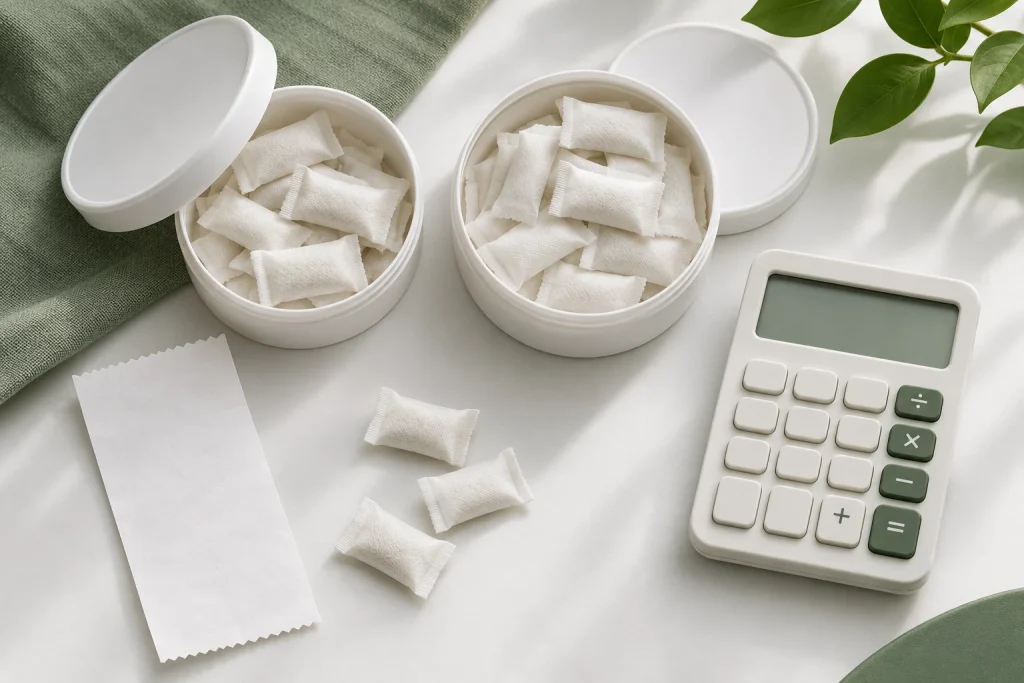
GuaranaPouches.com purchasing guide. All prices below are hypothetical examples, not live offers, quotations or suggested caffeine intakes.
Use one denominator for each comparison
A Reddit discussion about night-shift pouch choices compares price, count and caffeine strength. Another checkout-price question asks why the final amount differs from the expected price. Neither thread provides a controlled market survey. They do identify two practical questions: what does one pouch cost, and what will actually be charged?
NIST’s unit-pricing guidance explains why a consistent quantity basis helps compare package sizes. Applied here, divide the product price by pouch count. For a delivered-order comparison, include the same categories of unavoidable charges for every seller. State whether tax is included. Keep the product-only figure too, so shipping does not disappear into an unexplained unit price.
Work through a transparent example
Suppose Can A costs $8 and contains 20 pouches. Its product-only cost is $0.40 per pouch. Can B costs $9 and contains 30, giving $0.30 per pouch. B costs more at the shelf but less per unit. Now suppose an order of two A cans costs $16 plus $4 shipping. The delivered comparison is $20 divided by 40 pouches, or $0.50 each, before any tax that has not been included.
- Product-only cost per pouch = product price ÷ pouch count.
- Delivered cost per pouch = comparable checkout total ÷ total pouch count.
- Record currency, tax treatment and the date of the offer.
- Separate first-order promotions from repeat-order prices.
These examples describe money and quantity only. They say nothing about tested caffeine, comfort, ingredient quality or whether the product suits a particular user.
Keep caffeine normalization out of dose recommendations
A reviewer may calculate cost per 100 mg of labeled caffeine to compare ingredient economics. With a hypothetical $0.40 pouch labeled 40 mg, that arithmetic gives $1 per 100 mg. It does not tell a reader to use 2.5 pouches. Pouches are discrete finished products, and a lower price per milligram is not a reason to increase exposure or divide a pouch.
Use the label’s total caffeine figure, not the weight of guarana extract or a proprietary blend. Missing caffeine data makes this calculation unavailable. A comparison based on labeled content also cannot be renamed cost per absorbed milligram: that would require different evidence. Readers interested in the physiological distinction can consult the site’s release and absorption guide. A price table should retain those measurement boundaries.
Translate retail questions into a manufacturer brief
A retail can price includes a selling channel and commercial terms that do not describe an OEM quotation. Our published order requirement is at least 3,000 cans per SKU and at least 9,000 cans in total. Both conditions apply. This is a manufacturing order threshold, not a retail subscription requirement.
When asking about cost, specify pouches per can as well as cans per SKU. A quote for 15-pouch cans cannot be compared directly with one for 20-pouch cans. Request separate line items for the agreed testing scope, packaging, freight and any development work. The RFQ template covers the full specification; the MOQ and cost guide covers production purchasing. No retail price in a forum establishes our factory price.
Frequently asked questions
Is the cheapest can always the cheapest pouch?
No. Divide each can’s price by its pouch count. An $8 can containing 20 costs $0.40 per pouch; a $9 can containing 30 costs $0.30. These are hypothetical examples, not offers.
Should shipping be included when comparing online pouch orders?
For a delivered-cost comparison, yes. Apply the same treatment to every offer and record taxes separately if they are not yet known. Also retain product-only prices so the effect of shipping is visible.
How should a first-order subscription discount be compared with a one-off price?
Record both the introductory charge and the repeat-order charge, plus quantity and shipping. Read cancellation and renewal terms. A single promotional screenshot does not describe the ongoing cost.
Does cost per 100 mg of caffeine mean I should buy the strongest pouch?
No. That is an optional price-normalization calculation, not a dose recommendation or quality score. It ignores comfort, formulation suitability and individual sensitivity, and it should not encourage extra use.
Can I calculate value from guarana milligrams when total caffeine is undisclosed?
You can compare price per pouch, but not reliably price per milligram of caffeine. Guarana mass and total caffeine are different quantities. Ask for the missing finished-product information.
Does a retail pouch price tell me what a private-label can should cost?
No. Manufacturing quotations depend on the written specification and order terms. Retail margins, shipping promotions and subscriptions do not define an OEM price. Compare quotations with matching pouch counts and inclusions.
References and discussion context
Reviewed 16 November 2026. NIST provides the unit-pricing principle; the examples are original arithmetic. Reddit links identify purchasing questions, not verified competitor prices or endorsements. No current cheapest-brand ranking is asserted. For adult caffeine context, see FDA’s caffeine guidance; its population-level information is not a personal intake target.