
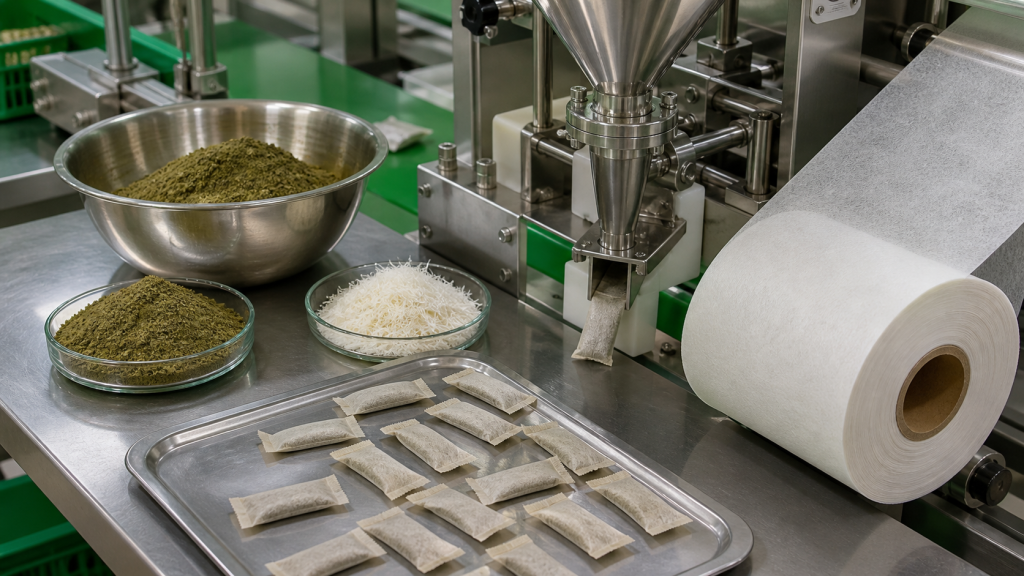
Commercial guarana pouch production is closer to controlled food-supplement manufacturing than to filling tea bags. Dose uniformity, moisture, seam quality and traceability all have to survive a fast converting line.
1. Qualify the guarana extract
The starting specification identifies Paullinia cupana, plant part, extraction method, carrier and caffeine assay. If the formula is built around a 20% caffeine extract, each lot’s numerical result is reviewed before batch quantities are calculated. Identity and contaminant controls cannot be replaced by caffeine testing alone.
2. Prepare the dry blend
Guarana extract is dispersed through a carrier such as food-grade cellulose with flavors, sweeteners and other permitted ingredients. Particle size, density and addition order are controlled to reduce segregation. A concentrated component is commonly pre-blended before entering the main mixer.
3. Adjust the functional phase
Water, humectants and flavor components may be introduced under controlled conditions. The target is not simply a “moist pouch”; it is a defined moisture or water-activity window that supports texture, release, microbiological quality and shelf life.
4. Form, fill and seal
A porous nonwoven web is shaped around a metered portion of fill, then sealed and cut. Operators monitor individual fill weight, pouch dimensions, seal temperature and seam integrity. Hopper residence time matters because an apparently uniform mixer can segregate during extended filling.
5. Verify the finished pouch
Representative samples are tested for caffeine per pouch, weight variation, moisture or water activity, microbiology, sensory profile and physical integrity. Early, middle and late run samples help reveal drift that one pooled sample could hide.
6. Pack with traceability
Cans and closures protect the selected moisture profile. Coding links the finished can to raw-material lots, production records and laboratory results. Retained samples then enter the stability program.
Reference
Content reviewed: . Review dates indicate editorial maintenance, not a new clinical study.